Every industrial laundry depends on one final moment to make good on its promises: the loading of the truck. Everything that happens before it, washing, ironing, folding, packing, only counts if the correct containers end up on the correct vehicle, in the correct order, within the correct weight limits. Yet in many operations, this critical step still relies on paper lists, memory, and trust.
That gap between production excellence and dispatch accuracy is where costly mistakes quietly accumulate. Missed items mean extra trips. Wrong containers mean customer complaints. Overloaded vehicles mean safety exposure. None of these problems show up clearly on a balance sheet, until they do, in the form of fuel costs, service credits, or a damaged customer relationship.
A verification layer for the moment that matters most
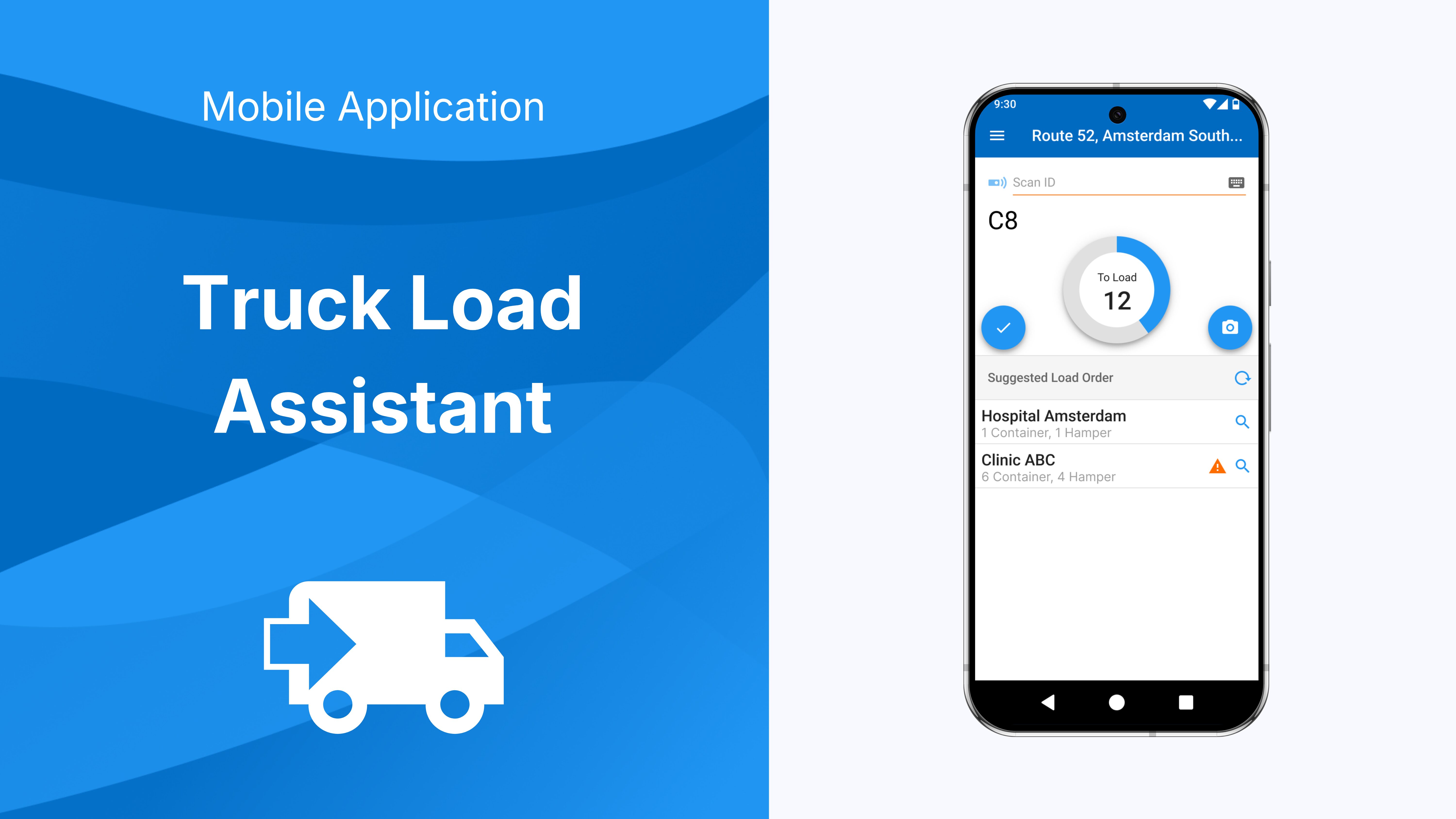
The Truck Load Assistant, or TLA, is a mobile application designed specifically for the dispatch and expedition area of industrial laundries. Rather than relying on a driver or loader to remember what belongs on which route, TLA guides the process step by step and validates every scan against the actual route data.
The flow is simple to follow, but the impact runs deep.
1
Scan to identify the route
A container or delivery note is scanned to identify the route.
2
Route details appear instantly
Driver, truck, and the full loading list are shown immediately.
3
The truck is confirmed
The truck itself is confirmed through its own barcode or registration plate.
4
Every container is scanned on board
Every container and delivery note is scanned as it is physically placed on the vehicle.
5
Progress is tracked continuously
Nothing is missed before departure.
What used to depend on a clipboard and a good memory now runs on a validated digital process, with a complete audit trail behind it.
Why this matters at board level, not just on the loading dock
Executive leadership rarely spends time thinking about barcode scanners. What executive leadership does spend time thinking about is service reliability, safety liability, and operational cost. TLA speaks directly to all three.
✅
Service reliability
Every scanned item is checked against the expected route before it is accepted, and items that do not belong are flagged immediately.
⚖️
Safety and legal exposure
Active weight monitoring raises a clear warning as soon as a truck approaches or exceeds its maximum weight, before loading continues.
🚚
Operational cost
Delivery stops are loaded in reverse sequence, so drivers unload in the correct order without extra handling at every stop.
Because TLA supports several people loading the same truck at once, with progress synchronized live from the server, larger laundries can scale their dispatch teams without losing visibility or control.
Built for real operations
Since its original release alongside ABSSolute, TLA has gone through a major redesign to support multiple containers per delivery note, faster finishing of a load when the situation calls for it, and clearer handling of unexpected items.
2019
Original release
TLA launches alongside ABSSolute.
2026
Weight capacity verification
Weight capacity verification is added, giving laundries a direct answer to a persistent safety concern.
TLA also does not operate in isolation. It works alongside the Truck Load Manager, giving expedition and transport managers full desktop oversight of routes, trucks, and capacity, and it connects directly into Route Assistant, so a completed load can be handed off to the driver’s device the moment loading finishes.
The bigger picture
Dispatch is where operational risk quietly hides
Industrial laundries compete on reliability as much as on price. A single missed delivered container can undo the trust built over years of consistent service. The Truck Load Assistant turns the final, most exposed step of the delivery chain into a verified, documented, and guided process, protecting both the customer relationship and the operation behind it.